Architecture
Router Protocol is built on the concept of a programmable execution graph: a dynamic network where bridges, DEXs, solvers, and messaging protocols act as nodes and edges, enabling unified, fault-tolerant cross-chain workflows.
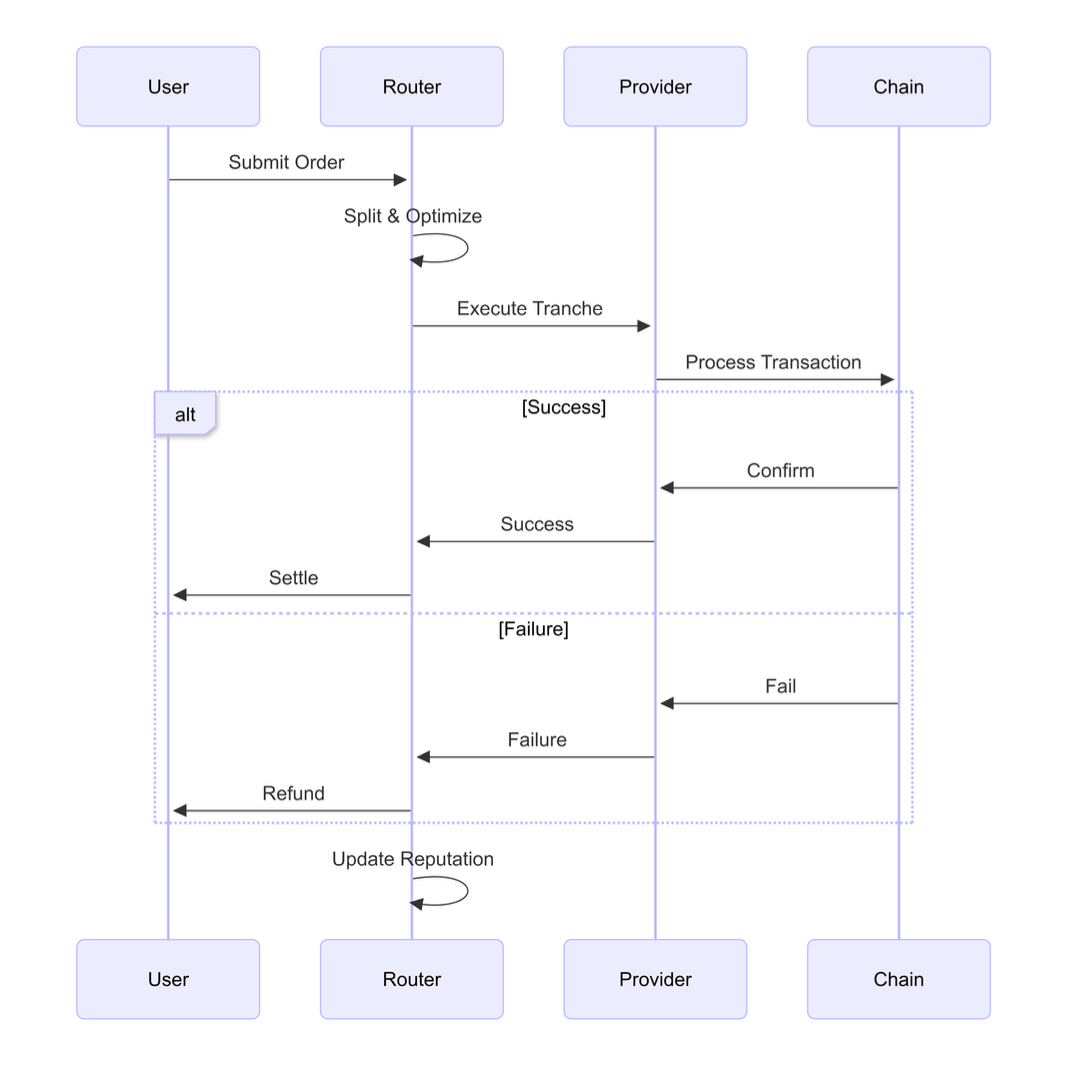
Programmable Execution Graph
The defining idea of Router Protocol is that of a programmable execution graph: a dynamic network where bridges, DEXs, solvers, and messaging protocols act as nodes and edges, enabling unified, fault-tolerant cross-chain workflows. In contrast to earlier systems where execution was locked into monolithic paths, Router's graph-based architecture enables dynamic routing and composability.
Core Primitives
Router OGA consists of six core primitives that work together to provide efficient, reliable cross-chain execution:
1. Permissionless Node Registry & Reputation
Instantly onboards bridges, DEXs, and solver nodes under EIP-712 authentication, with on-chain reputation scoring to favor reliable execution.
Key Features:
- EIP-712 Authentication: Secure, standardized node onboarding
- On-chain Reputation Scoring: Real-time reputation tracking to favor reliable execution
- Permissionless: Anyone can register a node and participate in the network
- Dynamic Discovery: Nodes are discovered and registered automatically
2. Split-and-Optimize Engine
Parallelizes large orders into sub-tranches across multiple venues, achieving sub-10 bps slippage on trades up to $50 million.
How it Works:
- Order Splitting: Large orders are automatically split into optimal sub-tranches
- Parallel Execution: Sub-tranches execute in parallel across multiple venues
- Cost Optimization: Real-time calculation of splitting benefits versus additional gas
- Scale Benefits: Larger network creates compounding benefits through economies of scale
Benefits:
- Sub-10 bps execution costs on block-size trades
- Handles trades up to $50 million
- Optimal capital allocation across venues
- Reduced slippage through parallel execution
3. Unified Messaging Hub & Isolated Revert Logic
Adapts between cross-chain protocols (LayerZero, Wormhole, etc.) at runtime and confines failures to individual hops, reducing end-to-end revert risk below 0.5%.
Key Features:
- Protocol Adaptation: Automatically adapts between different cross-chain messaging protocols
- Isolated Revert Logic: Failures are confined to individual hops, not the entire transaction
- Partial Execution: Users receive partial execution benefits even when some infrastructure fails
- Fault Tolerance: System continues operating even when individual nodes fail
Security Benefits:
- Reduced Exposure: Users receive partial execution benefits even when some infrastructure is compromised
- Limited Attack Rewards: Per-tranche isolation caps the maximum economic benefit of attacks
- Lower Revert Risk: End-to-end revert risk reduced below 0.5%
4. Modular Hook Architecture
Exposes on-chain hooks for dynamic fee modules, governance-driven routing policies, and custom workflows—enabling seamless integration with developer SDKs and composable order NFTs.
Capabilities:
- Dynamic Fee Modules: Customizable fee structures
- Governance-driven Routing: Community-controlled routing policies
- Custom Workflows: Build custom execution flows
- Composable Order NFTs: Represent orders as NFTs for composability
- SDK Integration: Seamless integration with developer tools
5. Execution & Liquidity Oracles
Provides time-weighted average execution cost and on-chain liquidity metrics to power automated risk management and back-testing.
Features:
- Execution Cost Metrics: Time-weighted average execution costs
- Liquidity Metrics: Real-time on-chain liquidity data
- Risk Management: Power automated risk management systems
- Back-testing: Historical data for strategy validation
6. Real-time Reputation System
Tracks node performance in real-time and adjusts routing preferences accordingly.
Components:
- Performance Tracking: Monitor success rates, execution times, and costs
- Dynamic Scoring: Real-time reputation updates
- Routing Optimization: Automatically favor high-performing nodes
- Network Health: Overall network performance monitoring
Architecture Benefits
For Institutions & Professional Traders
- Large Order Handling: Execute block-size trades (≥$5 million) with minimal slippage
- Reliability: 99.5% settlement reliability ensures trades complete successfully
- Cost Efficiency: Sub-10 bps execution costs reduce trading overhead
- Risk Management: Isolated revert logic limits exposure
For DeFi Protocols
- Composability: Modular hook architecture enables custom workflows
- Integration: Easy integration with existing DeFi infrastructure
- Flexibility: Adapt to different cross-chain messaging protocols
- Scalability: Network grows with more nodes, improving performance
For Node Operators
- Permissionless: Anyone can register and operate a node
- Competition: Healthy competition drives innovation and cost reduction
- Reputation: Build reputation through reliable execution
- Economic Benefits: Participate in network growth and fee distribution
Network Effects
As the network grows, all participants benefit:
- Competition Benefits: Increased node competition drives down costs and improves service quality
- Liquidity Benefits: More nodes mean deeper liquidity pools
- Reliability Benefits: More nodes provide redundancy and fault tolerance
- Ecosystem Benefits: Better execution efficiency benefits all DeFi participants
Technical Specifications
- Node Integration Overhead: ~100 lines of smart-contract code
- Settlement Reliability: 99.5% across five live chains
- Execution Costs: Sub-10 bps on block-size trades
- Revert Risk: <0.5% end-to-end revert risk
- Trade Capacity: Up to $50 million per trade
- Supported Protocols: LayerZero, Wormhole, and other cross-chain messaging protocols
Next Steps
- Learn about Supported Chains
- Explore the API Reference to start integrating
- Check out Integrate Into OGA to add your node